 Follow
 @SuncoastTools

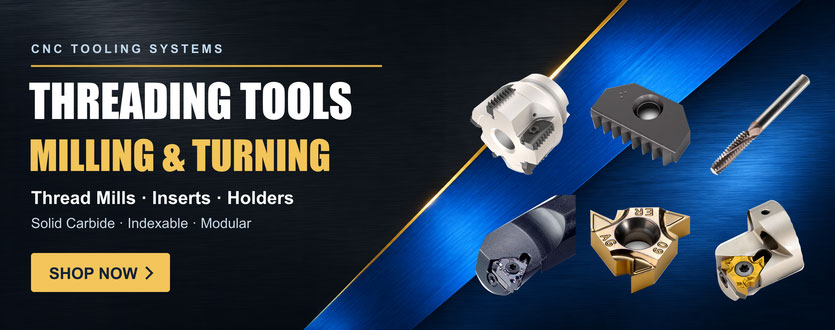

Ingersoll Thread Mills, Laydown Inserts & Threading Holders
Shop Ingersoll threading tools for thread milling and thread turning. Compare solid carbide thread mills, indexable thread mill bodies and inserts, TThread laydown tooling, I-Notch systems and dedicated small-bore options. Establish the thread standard, pitch and internal or external application first, then select the matching cutting geometry, holder and working reach.
Solid Carbide Thread Mills
Solid carbide thread mills generate the specified thread with a suitable milling toolpath. Compare thread form, TPI or metric pitch, cutter diameter and usable reach, along with the tool’s internal or external application. Confirm that the machine and programming support the required interpolation and entry clearance.
Indexable Thread Mills & Inserts
Indexable thread milling separates the cutter body from its replacement inserts. Match the insert profile and pitch range to the particular cutter and thread requirement. Then check the body diameter, connection and reach; cutter bodies and inserts have separate searches so each component can be selected by its own dimensions.
TThread Laydown Threading
TThread laydown inserts and holders cover listed thread-turning applications on the lathe. Compare internal and external holder arrangements, insert size, hand, thread form and pitch. T-Modular threading heads provide another assembly option when paired with their specified connection and compatible inserts.
I-Notch Threading Inserts & Holders
I-Notch threading uses the specified threading insert profile and holder configuration. Match the thread form, pitch, insert size and hand to the application, then check internal clearance or the external approach. Grooving inserts with a related family name are not substitutes for the required threading geometry.
GoldFlex & FaceFlex Threading
Dedicated GoldFlex and FaceFlex threading categories separate their thread-cutting inserts from other cutting profiles. Choose the listed insert and compatible holder or adapter for the operation. GoldFlex searches also include modular and FlexTurn components; verify the pocket and connection at both ends of the assembly.
T-Micro Small-Bore Threading
T-Micro threading inserts and sleeves support the listed small-bore threading arrangements. Check minimum bore, thread profile, pitch and working depth against the part. The sleeve must fit the selected cutting component and machine station, with enough clearance for the tool to reach and leave the thread.
Identify Thread Form, Pitch & Profile
Start with the drawing’s thread standard and TPI or metric pitch. Distinguish internal from external threading and confirm whether the selected insert has a full or partial profile. A shared thread angle does not establish the same standard, pitch range or finished crest geometry.
Choose the Process & Check Reach
Thread milling and thread turning use different machine motions and cutting arrangements. Consider the available machine, bore clearance, thread depth and required approach. Check the usable cutting or working length separately from overall tool length, and allow for tool entry, runout and the drawing’s relief features.
Prepare the Hole & Complete the Assembly
Internal threading begins with a prepared hole appropriate to the thread form and process. Choose the drill or finishing tool from the holemaking range, then match the threading tool to its holder. For thread milling, also confirm the rotary holder, projection and machine-side connection.
Ingersoll Threading Tools: Selection Questions
- What is the difference between thread milling and thread turning?
- Thread milling uses a rotating cutter and a coordinated milling toolpath. Thread turning uses the lathe’s coordinated workpiece rotation and tool feed. Select the tool for the available process, thread geometry, diameter and access.
- Can one thread mill produce several thread diameters?
- Some designs can produce different diameters sharing a supported thread form and pitch, subject to cutter size and application limits. Other tools have more specific geometry. Check the particular thread mill’s supported range and programming guidance.
- How do full-profile and partial-profile threading inserts differ?
- A full-profile insert is intended for its specified thread form and pitch and can generate the corresponding crest. A partial-profile insert serves its listed pitch range but does not provide the same full-profile crest geometry. Select according to the finished-thread requirement.
- Can an external threading insert be used inside a bore?
- Use the internal or external application specified for the insert and holder combination. Check orientation, hand and clearance; the same pitch designation alone does not establish that the assembly can machine an internal thread.
- Do indexable thread mills include the inserts?
- Bodies and replacement inserts have separate shopping categories. Read the listing or kit contents, then select the compatible insert profile, pitch and grade for the cutter body and work material.
- What should I check before ordering a T-Micro threading tool?
- Confirm thread profile and pitch, minimum bore, working depth and the compatible sleeve. Also check cutting direction and machine access. A T-Micro boring or grooving insert is not automatically a threading insert.