 Follow
 @SuncoastTools

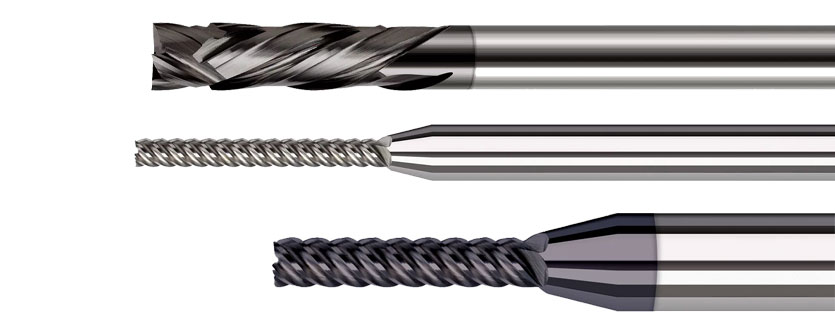

Harvey Tool End Mills by Work Material & Application
Find Harvey Tool material specific end mills for aluminum, hardened steel, titanium, high-temperature alloys, plastics, composites and other work materials. These families organize tools by application as well as cutting profile. Start with the alloy and material condition, then compare cutter diameter, flute geometry, reach and coating for the operation.
Aluminum Alloy End Mills
Compare square, ball and corner radius tools for aluminum alloys, including high helix and variable helix families. Roughing and finishing operations can require different geometries. Check the listed alloy application, cutting length and chip clearance before selecting a tool.
Hardened Steel End Mills
Choose a family matched to the workpiece hardness and operation. Harvey Tool separates hardened-steel tools by profile, reach and application range. Compare the exact item’s hardness recommendation and coating; a hardened-steel label alone is not a complete selection specification.
Titanium & High-Temperature Alloys
Explore dedicated titanium variable pitch end mills and separate high-temperature alloy families. Confirm the actual alloy, hardness and operation. Compare square and corner radius profiles with finishing or long reach options appropriate to the part.
Medium Alloy & Free-Machining Steel
Use the steel grade and condition to distinguish these application groups. Compare square, ball and corner radius profiles alongside finishing geometries. Select flute length and reach from the feature dimensions, then check the recommended coating and cutting data.
Plastic Milling Tools
Compare upcut and downcut tools, single- and two-flute designs, and dedicated finishing options. Plastic type, reinforcement and edge requirements affect selection. Review the family’s chip-flow direction and application rather than assuming every plastic uses the same geometry.
Composite Milling Tools
Browse compression, chipbreaker, straight flute and diamond-cut geometries for composite applications. Identify the reinforcement, laminate and edge requirements first. Diamond-cut describes a cutting geometry; review the item separately for substrate and coating information.
Diamond Tools for Listed Non-Ferrous Materials
Compare CVD diamond-coated and PCD diamond-tipped end mills for the applications specified by Harvey Tool. These are separate constructions, with square, ball and corner radius choices in the range. Confirm material compatibility, edge geometry and dimensions on the exact tool.
Wood Milling: Upcut & Downcut
Harvey Tool’s wood milling categories include upcut and downcut designs. Compare the tool’s chip-flow direction with the workholding, edge condition and operation. Check the material and application guidance before selecting a cutter for solid wood or a wood-based panel.
Confirm Material, Reach & Toolholding Together
Record the material grade and hardness, desired profile, cutting depth and available machine capability. Use the manufacturer’s cutting data for the actual series and setup. If the feature needs a different profile or additional clearance, compare the miniature and holder ranges.
Material Specific End Mills Questions
- Why choose a material specific end mill?
- Its geometry and available coatings are organized around particular work-material applications. Match the tool family to the actual alloy or nonmetallic material, then select the dimensions needed for the feature.
- How do I select a hardened-steel tool?
- Use the known material grade and hardness, then check the range listed for the exact cutter. Compare roughing or finishing use, profile, coating and reach before choosing a size.
- Are titanium and high-temperature alloy tools the same?
- They have separate families here. Start with the actual alloy and follow the selected series’ application guidance; do not assume that every tool in either group covers the other.
- What is the difference between CVD diamond and PCD?
- CVD diamond-coated tools use a diamond coating, while PCD diamond-tipped tools use polycrystalline diamond cutting tips. Confirm the construction and suitable materials on the individual listing.
- Does diamond-cut mean diamond-coated?
- No. In the composite categories, diamond-cut identifies the cutting-edge pattern. Coating and substrate are separate specifications that must be checked for the particular tool.
- Can I use one speed and feed for every material in a family?
- No. Use Harvey Tool’s data for the exact series, material and operation, accounting for tool size, engagement, reach and machine capability. A category name does not establish cutting parameters.